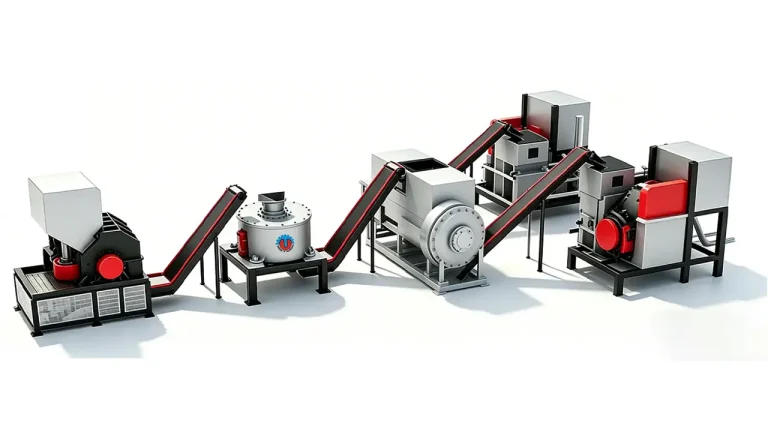
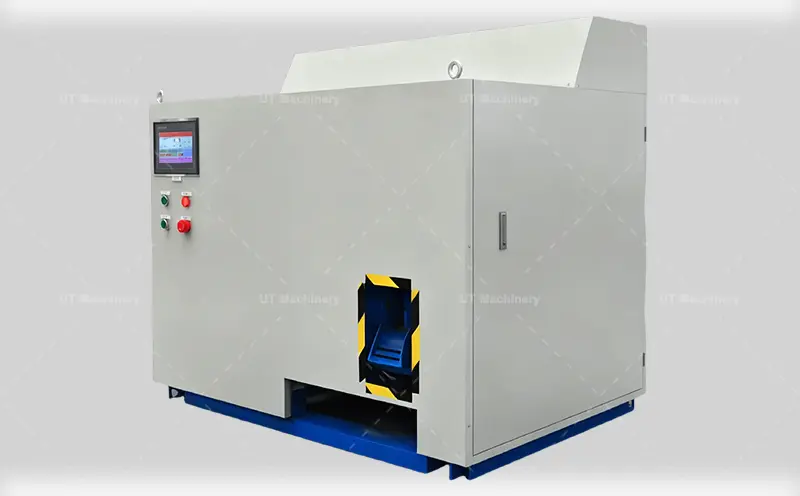
Metal Scrap Briquette Press
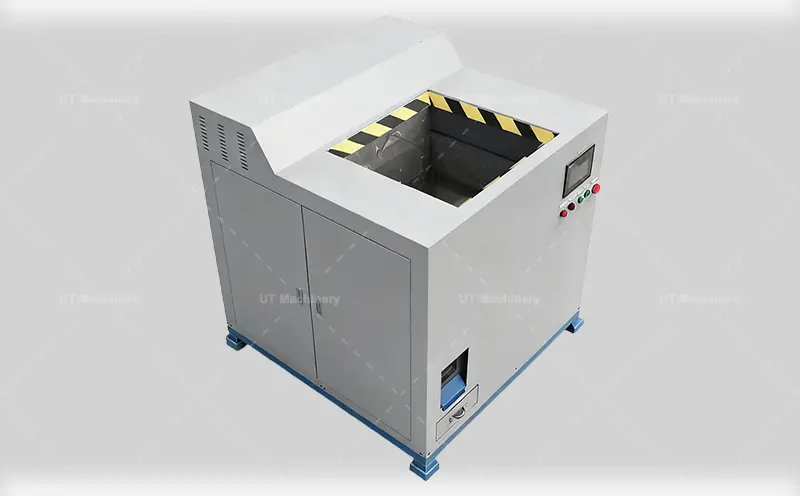
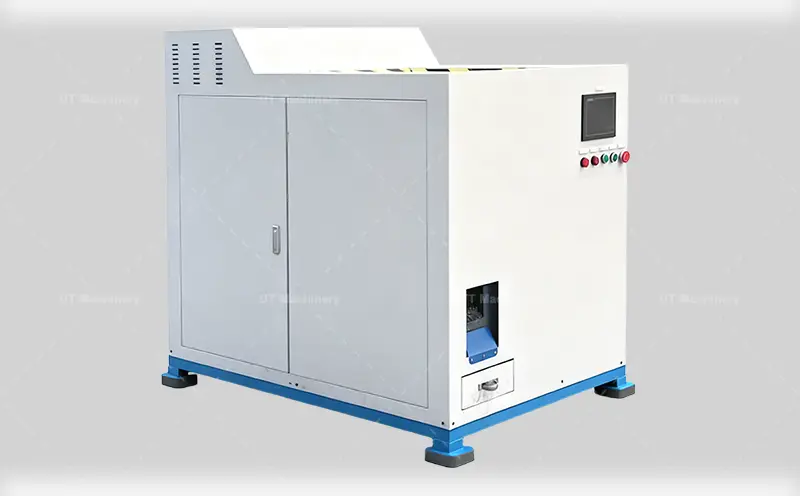
Aluminum Swarf Briquetting Press
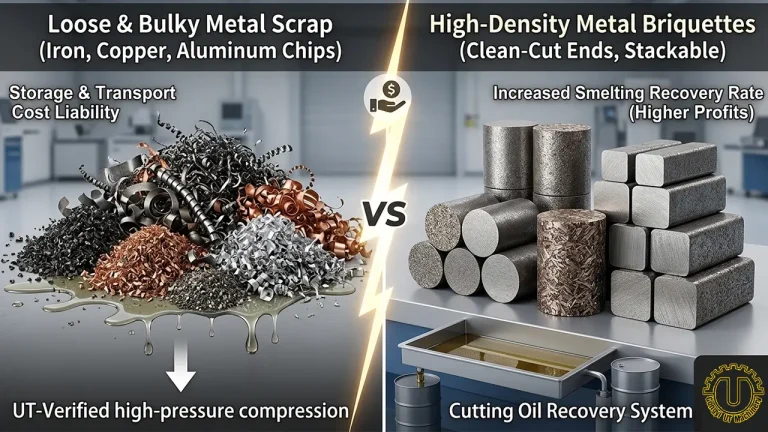
Stop paying to haul away bulky, fluid-soaked aluminum chips. An Aluminum Swarf Briquetting Press transforms messy scrap into high-density briquettes—creating a cleaner, safer floor while dramatically boosting your bottom line.
- Engineered for modern CNC machining plants, this industry-proven solution helps you:
- Maximize Scrap Value: Dense briquettes command top-dollar prices from recyclers.
- Recover Valuable Coolant: Reclaim expensive cutting fluids for immediate reuse.
- Optimize Shop Space: Reduce scrap volume by up to 90%, freeing up vital operational space.
Turn Aluminum Shavings/Chips into High-Value Briquettes
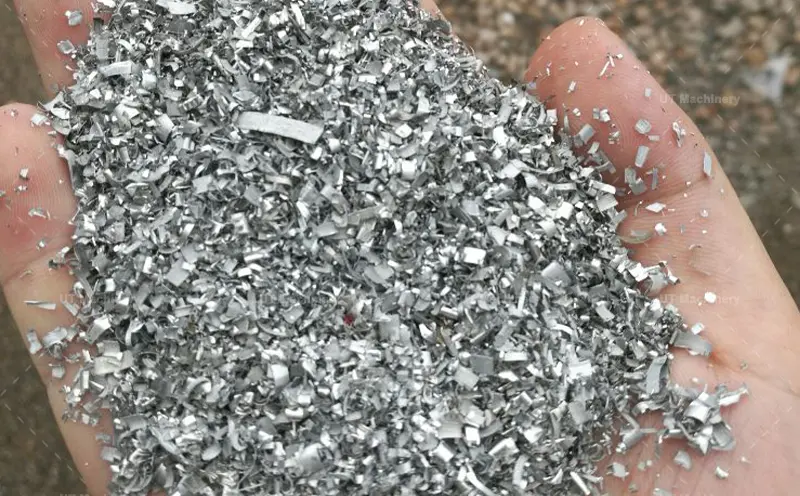
Aluminum chips pile up fast in CNC workshops. They tangle around feeders and drip cutting fluid onto the floor. These messy by-products waste space, labor, and money.
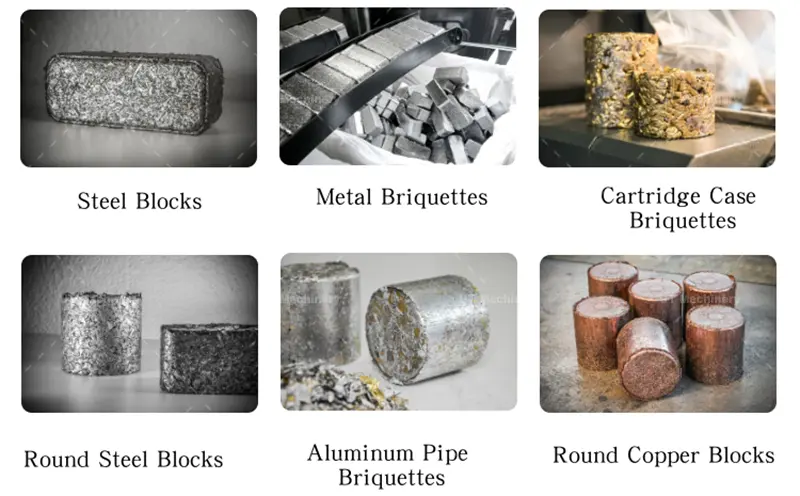
An Aluminum Swarf Briquetting Press compresses loose chips into dense, uniform briquettes, recovering up to 95% of coolant while producing a consistent, high-value material ready for recycling. These systems are also commonly called industrial aluminum chip compactors.
Why Machining Plants Invest in Aluminum Chip Briquetter
Aluminum chips come in various forms, and each presents its own handling challenge:
Table 1 – Aluminum Scrap Types and Handling Challenges
| Scrap Type | Source | Typical Challenge | How Briquetting Helps |
| Turning chips | CNC lathes | Long spirals wrap around augers | Compress into stable, manageable briquettes |
| Milling chips | Machining centers | Irregular shapes bridge in the hopper | Anti-bridging spiral feeder ensures smooth flow |
| Long continuous swarf | High-speed cutting | Bulky, low-density material | Volume reduced up to 90%, easy storage |
| Fine chips / powder | High-speed machining | Oxidation risk during melting | Dense briquettes minimize metal loss |
How Our Aluminum Chips Briquetting Press Solves Real Shop Problems
Many machines struggle with long or irregular swarf. Our system addresses these challenges directly:
- Anti-bridging spiral feeder: Prevents tangles and blockages from long chips.
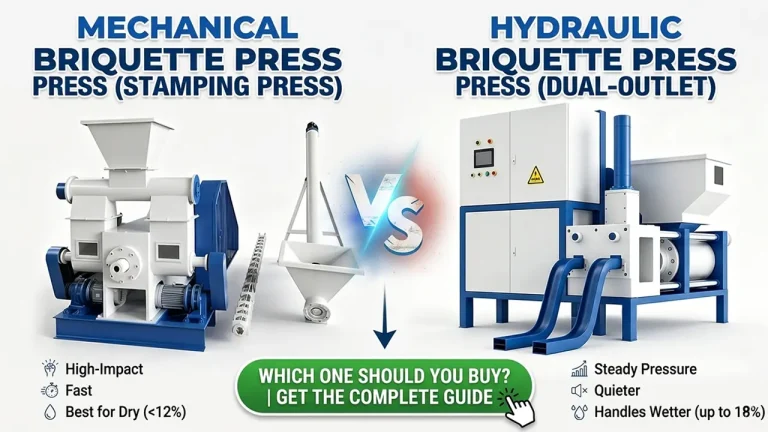
- Hydraulic compression system: Ensures uniform density for every briquette.
- PLC-controlled operation: Supports manual or fully automatic 24/7 operation.
- Coolant recovery system: Captures up to 95% of trapped cutting fluid.
- Density monitoring sensors: Guarantee consistent briquette quality for recyclers.
These features help machining plants maintain continuous production, reduce floor clutter, and improve recycling value.
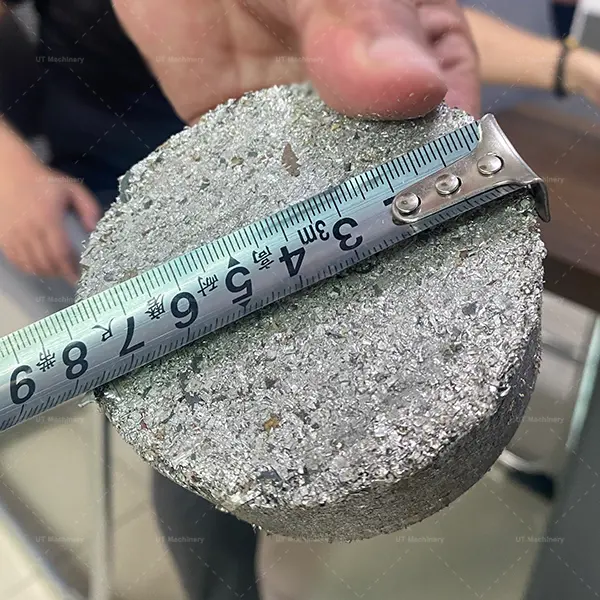

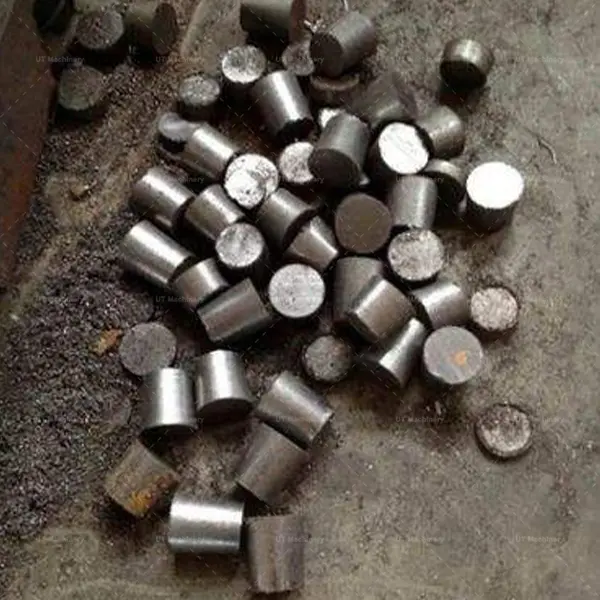
Loose Aluminum Chips vs Briquettes
Table 2 – Operational and Financial Comparison
| Factor | Loose Chips | Briquettes |
| Storage | Bulky, scattered | Compact, stackable |
| Coolant | Often lost on floor | Up to 95% recoverable |
| Handling | Manual cleaning, frequent bin replacement | Palletized, forklift-friendly |
| Recycling value | Lower due to irregularity | Higher-density, uniform material |
| Machine downtime | Frequent interruptions | Continuous operation with minimal labor |
Converting chips into briquettes improves efficiency and profitability while keeping the workshop cleaner and safer.
Machine Options and Throughput
Table 3 – Single vs Double Outlet Briquetters
| Machine Type | Typical Users | Key Specs |
| Single-Outlet Aluminum Swarf Briquetting Press | Small to medium CNC shops | Briquette diameter: 60–120 mm; Motor: 5.5–15 kW; Spiral feeding; Manual/automatic |
| Double-Discharge Aluminum Chip Briquetter | High-volume production plants | Capacity: 200–600 kg/h; Motor: 22–30 kW; Two briquettes per cycle; Optional chip crusher, tipping bucket, conveyor |
These systems can be customized for material type, volume, and shop layout, ensuring seamless integration with existing chip handling processes.
Ready to calculate your savings?
Ready to clean up your workshop, cut costs, and elevate your scrap recycling game? Contact us today to learn how our Aluminum Swarf Briquetting Press can transform your aluminum chips into a reliable revenue stream.
Frequently Asked Questions About Aluminum Swarf Briquetting Press
Q1: What specific density can I expect from the final briquettes?
A: Our Aluminum Swarf Compactor achieves a consistent density of 2.1 – 2.3 g/cm³, which is approximately 80-85% of solid aluminum. This is a critical benchmark because it transforms loose scrap into a “refinery-ready” asset. High-density briquettes significantly reduce the surface area exposed to air, meaning you lose less metal to oxidation during the melting process compared to loose chips.
Q2: How much coolant is realistically recoverable in a daily shift?
A: Depending on the initial moisture content, you can recover up to 95% of trapped cutting fluids. The high-pressure hydraulic stroke acts as a mechanical separator, forcing the lubricant into a dedicated, leak-proof collection tray. This reclaimed fluid can be filtered and returned directly to your processing line, drastically cutting your monthly cutting fluid spend.
Q3: What is the actual throughput for different aluminum alloys?
A: Throughput varies by material density and machine model. For example, our aluminum chips briquetter delivers roughly 150-200 kg/h, while the industrial-grade Double-Discharge system reaches up to 600 kg/h. If you are processing 6061 or 7075 alloys, the throughput remains stable due to our constant-pressure hydraulic logic.
Q4: Is the system designed for unattended, 24/7 operation?
A: Absolutely. By integrating Siemens PLC controls and infrared material sensors, the machine only cycles when the hopper is charged. This makes it a reliable aluminum puck maker for high-volume CNC workshops. You can synchronize it with your existing chip conveyors to run through second and third shifts without dedicated operator supervision.
Q5: What is the maintenance schedule for a compactor running multiple shifts?
A: We prioritize uptime with a “low-friction” design. Routine maintenance is limited to monthly hydraulic oil level checks and greasing the main pivot points every 500 operating hours. This reliable build quality is why we are a preferred industrial aluminum chip briquetter manufacturer for Tier-1 automotive and aerospace suppliers.
Q6: What is the typical power consumption per ton of processed aluminum?
A: Energy efficiency is a core engineering goal. On average, our Briquetting Systems consume between 15–22 kWh per ton of aluminum processed. We utilize IE3 high-efficiency motors and variable-displacement pumps that only draw peak power during the actual compression stroke, preventing energy waste during idle periods.
Q7: What is the estimated ROI and payback period for a medium-sized shop?
A: Most clients reach the “break-even” point within 6 to 8 months. This ROI is driven by three factors: the 15-25% price premium paid by recyclers for briquettes, the 95% reduction in coolant replacement costs, and the 90% reduction in waste hauling frequency.