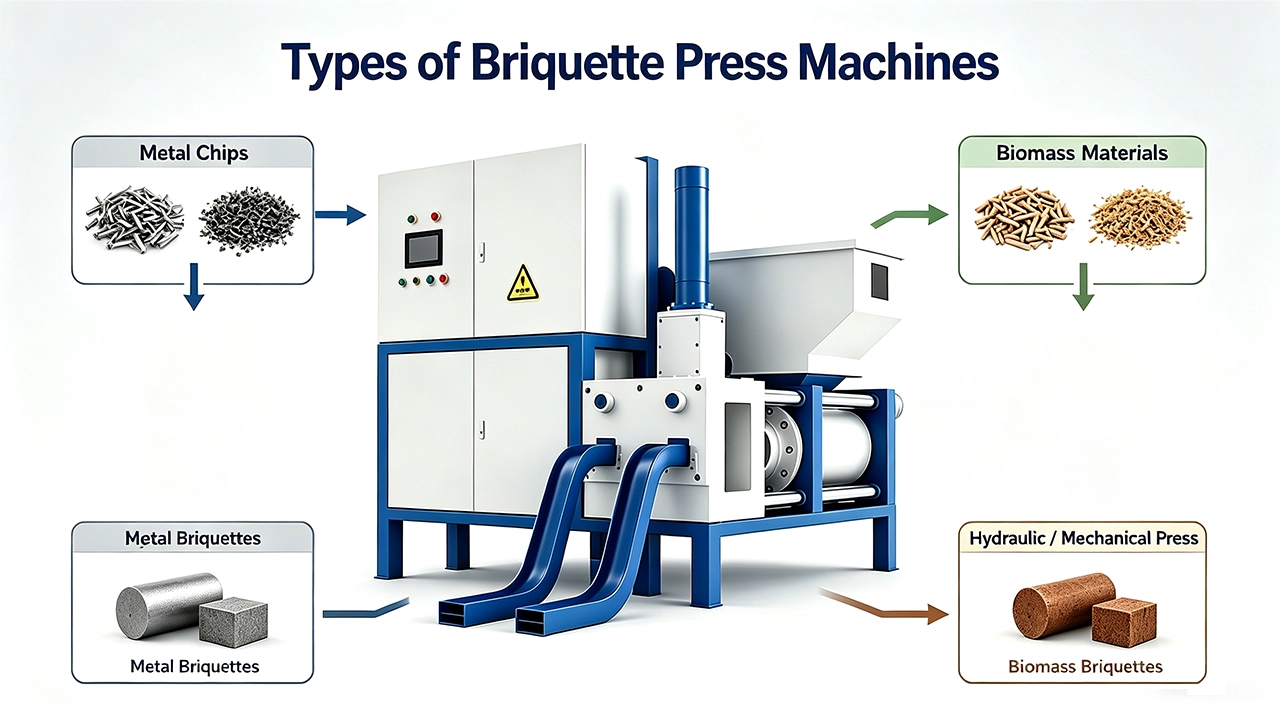
Types of Briquette Press Machines: Technology and Selection Guide
Choosing the right briquette press is less about the machine’s capacity and more about matching the pressing technology to your material’s physical properties.
Whether you are looking to recover high-value cutting fluids from metal chips or convert wood waste into dense biomass fuel, the machine’s structure and compression method are the deciding factors for performance. Using the wrong technology often leads to frequent jams, excessive maintenance, or poor output density.
This guide breaks down the four common briquette press technologies—Hydraulic, Mechanical, Screw, and Roller—to help you select a system that aligns with your specific material and factory floor requirements.
Introduction
Briquette press machines are designed with different structures and pressing methods to handle various raw materials and production conditions.
Although all briquetting equipment uses compression to increase material density, the actual machine configuration can vary significantly depending on the material being processed. Factors such as material hardness, moisture content, particle size, oil content, required output, and final briquette requirements all influence the selection of a suitable briquette press.
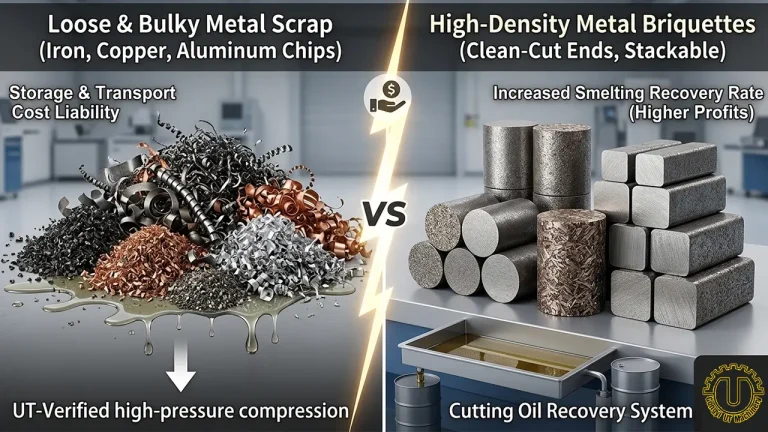
For example, metal processing plants usually deal with materials such as aluminum chips, steel turnings, and cast iron borings generated during machining operations. These materials often have low bulk density and may contain residual cutting oil, requiring strong compression force and suitable handling systems.
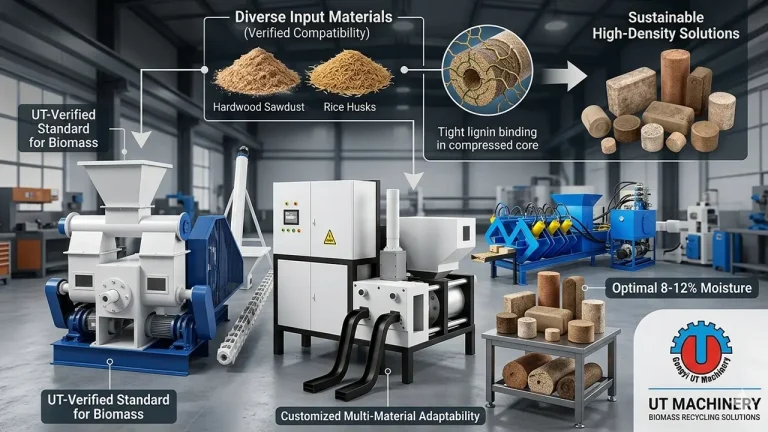
On the other hand, woodworking factories and agricultural processing facilities typically process biomass residues such as sawdust, wood chips, and agricultural waste. These materials require proper preparation, including moisture control and stable feeding, to achieve consistent briquette quality.
Choosing the correct type of briquette press machine helps factories improve material handling, maintain stable production, and avoid unnecessary equipment problems caused by unsuitable machine selection.
This guide explains the main types of briquette press machines based on pressing technology, raw material application, and production requirements, including hydraulic, mechanical stamping, screw, and roller briquetting systems.
For a complete overview of briquette press working principles, applications, and production solutions, please refer to our Complete Guide to Briquette Press Machines.
Types of Briquette Press Machines Based on Pressing Technology
The pressing mechanism is one of the main factors that determines how a briquette press operates.
Different technologies generate compression force in different ways. As a result, each machine type has different advantages and is suitable for specific material conditions.
The four commonly used briquetting technologies include:
Hydraulic compression
Mechanical stamping
Screw extrusion
Roller compaction
Among these technologies, hydraulic and mechanical stamping briquette presses are the most widely used in industrial applications involving metal recycling and biomass processing.
1.Hydraulic Briquette Press
A hydraulic briquette press uses a hydraulic cylinder to generate compression force and compact loose materials inside a forming chamber.
Unlike mechanical stamping systems, hydraulic presses use controlled hydraulic pressure to adjust the compression force according to different material characteristics and briquette requirements.
Because of its flexible pressure control and strong compression capability, hydraulic technology is widely used for both metal recycling and biomass briquetting applications.
In metal processing industries, hydraulic briquette presses are commonly used for materials such as aluminum chips, steel chips, copper chips, and cast iron borings generated during machining operations.
These materials usually have low bulk density and may contain cutting oil or coolant. Hydraulic compression helps convert loose chips into compact briquettes, making storage, transportation, and recycling handling easier.
Hydraulic briquette presses are also used for biomass applications, including:
- Sawdust
- Wood chips
- Agricultural residues
- Other biomass materials
For biomass briquetting, the machine configuration usually focuses on factors such as material moisture, particle size, feeding stability, and required briquette density.
The suitable hydraulic briquette press configuration depends on:
- Raw material type
- Material characteristics
- Required output
- Briquette size and density
- Production conditions
For example, a hydraulic press used for aluminum chips requires different configuration considerations from a hydraulic biomass briquette press processing sawdust or wood residues.
2.Mechanical Stamping Briquette Press
A mechanical stamping briquette press uses a motor-driven flywheel and crank mechanism to create repeated piston movement.
During operation, the piston continuously compresses prepared material inside the forming chamber to produce briquettes with consistent shape and density.
Compared with hydraulic systems, mechanical stamping briquette presses are usually selected for applications that require continuous operation and stable production output.
This technology is commonly used in biomass processing industries, especially where large quantities of prepared biomass materials need to be continuously converted into compact briquettes.
Typical biomass materials include:
- Sawdust from woodworking operations
- Wood chips and processing residues
- Agricultural biomass waste
However, biomass briquetting performance depends heavily on material preparation.
Unlike metal chips, biomass materials usually require attention to:
- Moisture condition
- Particle size distribution
- Feeding stability
- Material consistency
For example, sawdust with excessive moisture may affect briquette formation, while oversized particles may cause unstable feeding or increased wear on machine components.
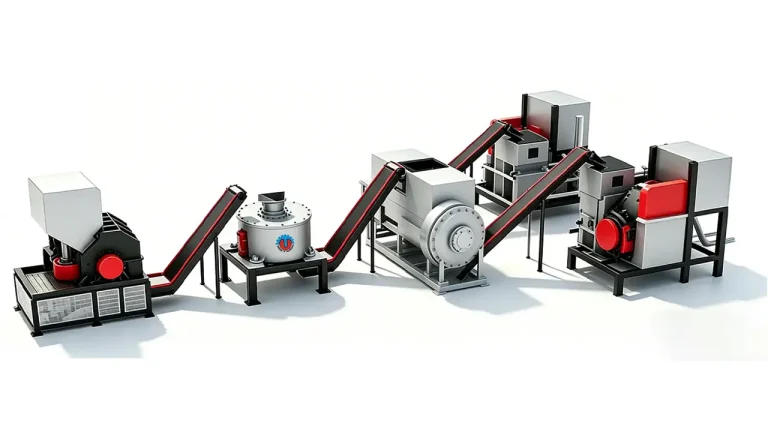
In practical production environments, mechanical stamping briquette presses are often combined with upstream equipment such as crushers, dryers, storage bins, and feeding systems to create a continuous biomass briquetting process.
For biomass processing applications, see our Biomass Briquette Press solutions.
Comparison Between Hydraulic and Mechanical Stamping Briquette Press
Although both machines use compression technology, their working principles and application areas are different.
| Feature | Hydraulic Briquette Press | Mechanical Stamping Briquette Press |
|---|---|---|
| Compression method | Hydraulic cylinder pressure | Flywheel-driven piston movement |
| Main application | Metal chips and selected biomass materials | Biomass materials |
| Pressure control | Adjustable according to material conditions | Determined by mechanical structure |
| Operation mode | Batch or semi-continuous | Continuous production |
| Key factors | Material density, oil content, compression force | Moisture, particle size, feeding stability |
In general:
- Hydraulic briquette presses are commonly selected not only for metal recycling applications requiring high compression force, but also for biomass applications.
- Mechanical stamping briquette presses are commonly selected for biomass applications requiring continuous production.
The final choice should always be based on actual material characteristics and production requirements rather than only comparing machine specifications.
3.Screw Briquette Press
A screw briquette press forms briquettes through a continuous extrusion process.
During operation, a rotating screw pushes prepared material forward and forces it through a forming die. The pressure generated during extrusion compresses the material into a continuous briquette shape.
This type of briquette press is mainly used for specific biomass applications where continuous extrusion and particular briquette shapes are required.
Compared with hydraulic and mechanical stamping systems, screw briquette presses have different operating characteristics. The screw and forming die are continuously exposed to friction during operation, so wear of these components needs to be considered during long-term production.
Typical considerations for screw briquette presses include:
- Raw material characteristics
- Required briquette shape
- Die and screw wear
- Maintenance requirements
- Production conditions
For biomass materials, the natural binding characteristics of the material can influence briquette formation. Therefore, proper preparation of raw materials remains an important factor in achieving stable production.
4.Roller Briquette Press
A roller briquette press uses two rotating rollers to compress fine materials between specially designed forming cavities.
Unlike hydraulic and mechanical stamping presses, roller briquetting is mainly used for powder-based materials where continuous roller compaction is suitable.
Common applications include:
- Coal powder
- Mineral powders
- Chemical materials
- Fine industrial powders
This type of equipment is generally not selected for metal chips or fibrous biomass materials because these materials require different compression mechanisms and preparation methods.
When selecting a roller briquette press, factors such as material characteristics, binder requirements, and final briquette application need to be considered.
Types of Briquette Press Machines Based on Raw Material
Besides pressing technology, briquette machines can also be classified according to the materials they process.
In practical industrial applications, the raw material is often the first factor considered when selecting equipment.
A machine suitable for metal chips may not be suitable for biomass materials because the two materials have very different physical characteristics.
1.Biomass Briquette Press
A biomass briquette press is designed to compress loose biomass residues into compact briquettes for easier handling, storage, transportation, or utilization.
Biomass materials are usually lightweight and have relatively low bulk density. Before pressing, these materials often require preparation to achieve stable feeding and consistent briquette quality.
Common biomass materials include:
- Sawdust
- Wood chips
- Wood processing residues
- Agricultural waste
In woodworking factories and agricultural processing facilities, biomass waste is often generated as a by-product of production. Without proper processing, these materials may require significant storage space and handling effort.
A biomass briquette press increases material density through compression, making the processed material easier to manage and transport.
However, successful biomass briquetting depends on several production conditions, including:
- Material moisture content
- Particle size
- Feeding stability
- Required briquette density
For larger production applications, a biomass briquette press is often integrated with additional equipment such as:
- Crusher
- Dryer
- Dust collection system
- Storage bin
- Conveyor system
This creates a complete biomass briquette production process rather than a standalone pressing operation.
For complete processing solutions, refer to our Biomass Briquette Production Line.
2.Metal Briquette Machine
A metal briquette machine is designed to compress loose metal waste generated from machining and metal processing operations.
During CNC machining, turning, milling, and other metalworking processes, large quantities of chips and borings can be produced. These materials usually have irregular shapes, low bulk density, and may contain residual cutting fluids.
Common materials processed by metal briquette machines include:
- Aluminum chips
- Copper chips
- Steel chips
- Cast iron borings
By compressing loose chips into dense briquettes, factories can improve storage utilization and simplify recycling handling.
In addition, when combined with suitable oil separation equipment, metal briquetting systems can help recover valuable cutting fluids from machining waste.
Metal briquette machine selection depends on:
- Metal type
- Chip size and shape
- Oil content
- Required processing capacity
- Recycling requirements
Typical applications include:
- CNC machining factories
- Foundries
- Metal processing plants
- Recycling facilities
For complete metal recycling solutions, refer to our Metal Briquetting Solution.
If you process aluminum or steel chips, check our Metal Briquette Machine page for specific model parameters and capacity options.
How to Select the Right Briquette Press Machine
Selecting a briquette press machine requires more than comparing machine capacity or pressing force.
The correct equipment should match the actual production conditions, including material characteristics, factory requirements, and final briquette usage.
1. Identify the Raw Material
The first step is determining what material will be processed.
Different materials require different pressing technologies.
For example:
- Metal chips usually require high compression force and suitable handling systems.
- Biomass materials usually require proper moisture control and material preparation.
2. Evaluate Material Characteristics
Before selecting equipment, factories should evaluate several material conditions:
- Moisture content
- Particle size
- Material consistency
- Oil or coolant content
- Bulk density
These factors directly influence machine selection and briquette quality.
3. Define Required Production Capacity
Production requirements determine the suitable machine size and system configuration.
Important questions include:
- How much material needs to be processed per hour?
- Is the operation continuous or intermittent?
- Is manual feeding acceptable?
- Is automatic material handling required?
A small standalone machine may be suitable for limited production, while larger factories may require a complete briquetting system.
4. Consider the Final Briquette Requirements
The required briquette characteristics should also be considered.
Depending on the application, factories may focus on:
- Briquette density
- Shape and size
- Storage requirements
- Transportation method
- Recycling or utilization purpose
5. Conduct Material Testing Before Investment
For industrial briquetting projects, testing actual raw materials before purchasing equipment is highly recommended.
Material testing helps confirm:
- Suitable pressing technology
- Expected briquette quality
- Required machine configuration
- Production stability
A machine that performs well with one material may not provide the same results with another material.
Conclusion
Briquette press machines are available in different designs because different materials have different physical characteristics, preparation requirements, and production conditions.
Hydraulic briquette presses are widely used across various applications, including metal recycling and biomass briquetting, where adjustable compression force and stable briquette formation are required. Mechanical stamping briquette presses are commonly selected for continuous biomass processing where stable feeding and production output are important.
Other technologies, including screw and roller briquette presses, are designed for specific materials and forming requirements.
Understanding the differences between briquette press types helps factories evaluate suitable equipment based on raw material characteristics, required capacity, briquette specifications, and final application requirements.
Before investing in briquetting equipment, factories should consider material properties, production conditions, and processing requirements to determine the most suitable machine configuration.
Frequently Asked Questions
What are the main types of briquette press machines?
The main types of briquette press machines include hydraulic briquette presses, mechanical stamping briquette presses, screw briquette presses, and roller briquette presses.
They can also be classified according to material application, such as biomass briquette presses and metal briquette machines.
Which briquette press is suitable for metal chips?
A hydraulic briquette press is commonly used for metal chips because it provides strong compression force and is suitable for materials such as aluminum chips, steel chips, copper chips, and cast iron borings.
The final selection depends on material characteristics, chip size, oil content, and required output.
What is the difference between hydraulic and mechanical briquette presses?
Hydraulic briquette presses use hydraulic cylinders to generate adjustable compression force, while mechanical stamping briquette presses use flywheel-driven piston movement.
Hydraulic systems are commonly used for metal applications, while mechanical stamping presses are widely used for continuous biomass processing.
Can one briquette press process both metal chips and biomass?
In most industrial applications, separate machine configurations are recommended.
Metal chips and biomass materials have different requirements for compression force, feeding methods, and material preparation.
Selecting a machine according to the actual raw material helps ensure stable production.
What factors should be considered when buying a briquette press machine?
The main factors include:
- Raw material type
- Material moisture and size
- Required production capacity
- Briquette requirements
- Automation level
- Available factory space