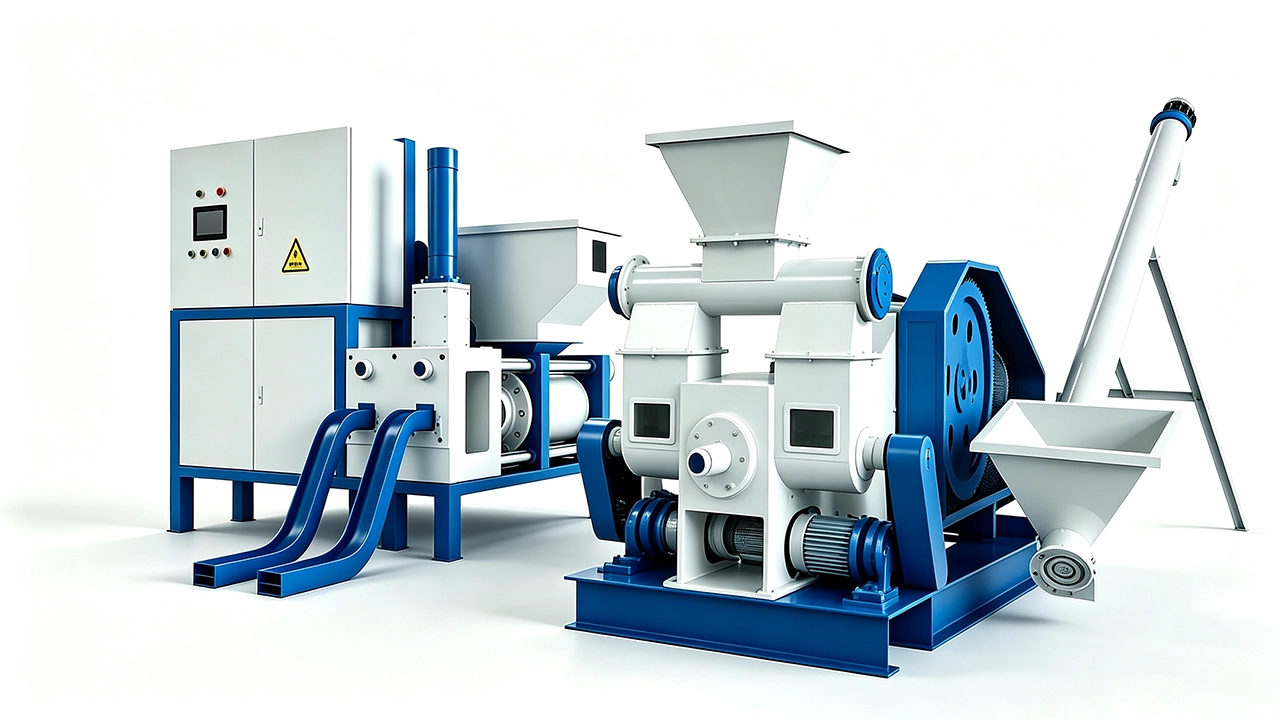
Hydraulic vs Mechanical Briquette Press: Understanding the Two Compression Technologies
Hydraulic and mechanical briquette presses use different approaches to densify industrial materials and biomass. Instead of simply comparing which machine is better, this guide explains how each compression technology works, how force is transferred to the material, and why different production conditions require different equipment designs.
When plant managers and project engineers start looking into briquetting lines, the debate almost always boils down to one fundamental choice: hydraulic or mechanical?
Both technologies handle the same core job—turning loose, messy scrap or biomass into dense, manageable briquettes to cut down on storage space and shipping costs. But how they actually deliver that compression force is worlds apart.
That single difference changes everything: machine footprint, power consumption, maintenance routines, and how well the machine handles unpredictable raw materials.
A common misconception in the market is that hydraulic presses are strictly for metal chips, while mechanical stamping presses only belong in biomass plants. In reality, choosing the right system isn’t about rigid industry labels. It comes down to material behavior, required density, production throughput, and what your shop floor looks like on a day-to-day basis.
Why Different Briquetting Technologies Exist
Raw materials don’t all behave the same way under pressure.
Some materials are stubborn—they have high elasticity, irregular particle sizes, or massive internal air gaps that require sustained, heavy compaction to lock together. Others are generated continuously in massive, high-volume streams on a factory floor, demanding rapid-fire processing rather than slow, heavy squeezing.
Because feedstocks vary so wildly, engineering solutions split into two distinct paths:
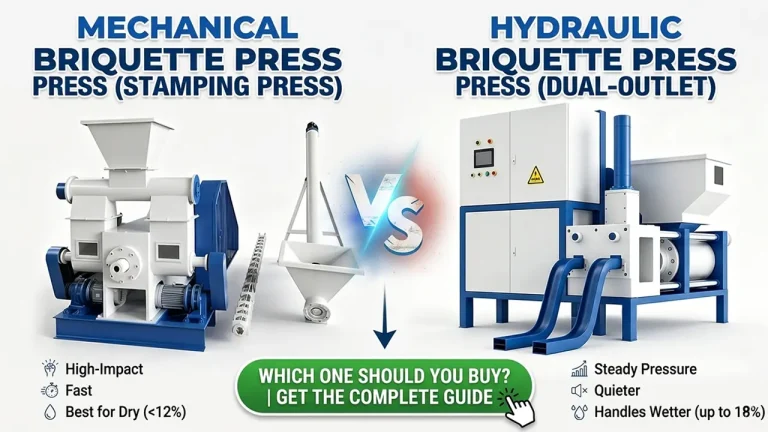
- Hydraulic systems rely on controlled, fluid-driven static pressure. They excel when you need adjustable force and deep, uniform compaction.
- Mechanical systems rely on stored kinetic energy, driven by flywheels and crankshafts to deliver rapid, repeating impact strokes.
Neither technology is universally “better.” Each is simply engineered to solve a completely different set of production bottlenecks.
How a Hydraulic Briquette Press Generates Compression Force
A hydraulic press is built around fluid power. An electric motor drives a high-pressure pump, pushing hydraulic oil into cylinders that drive the main ram forward into the compression chamber.
Unlike impact-driven machines, hydraulic compression builds pressure gradually and, crucially, can hold that pressure (dwell time) at the end of the stroke.
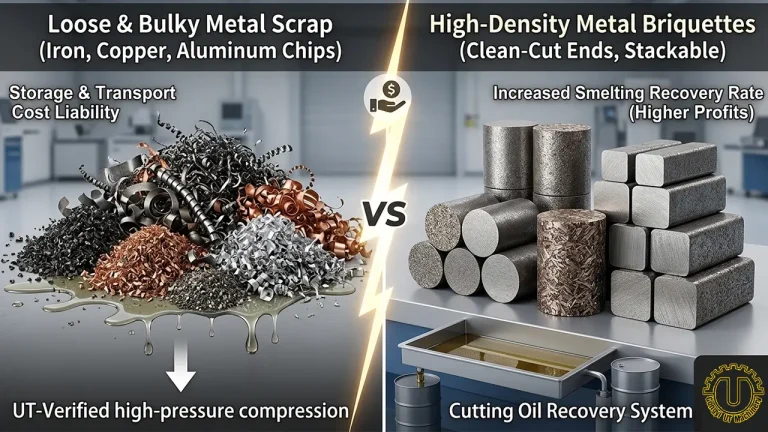
This controlled, steady squeeze gives you a massive operational advantage when dealing with tricky materials. If you need to squeeze every last drop of residual cutting oil out of an aluminum turnings batch, or if your biomass feedstock varies in moisture and consistency, hydraulic systems give you the flexibility to adjust pressing parameters on the fly.
Key operational traits of hydraulic presses:
- Infinitely adjustable pressing force
- Controlled compression and dwell cycles
- High tolerance for variable or difficult material conditions
- Excellent density consistency when paired with the right feedstock
How a Mechanical Stamping Briquette Press Works
Mechanical presses take the opposite approach. Instead of relying on fluid dynamics, they use a high-inertia motor-driven flywheel, a heavy crankshaft, and a connecting rod.
This mechanical assembly converts continuous rotary motion into a high-speed, linear stamping action. The piston smashes forward into the forming chamber on a fixed, repeating cycle, compressing the material before returning to the next cycle.
The defining characteristic of mechanical stamping is raw speed and rhythm.
Because the machine operates on a fixed mechanical cycle, it thrives in high-volume, predictable environments. If your upstream line feeds a steady, homogenous stream of material at a constant rate, a mechanical press can churn out briquettes at a pace hydraulics simply can’t touch.
Key factors driving mechanical performance:
- Requires stable and consistent material feeding
- Strict limits on particle size and moisture variations
- High-speed, repetitive production cycles
- Rigid mechanical tolerances
Continuous Pressure vs. Mechanical Stamping Force
The real differentiator between these two machines isn’t just what parts are inside—it’s how the energy is transferred to the material.
- Hydraulic presses apply a “squeeze.” The force ramps up, holds steady, and lets the material relax into shape under sustained pressure.
- Mechanical presses apply a “punch.” The force is delivered as a rapid shock wave within a split-second mechanical cycle.
Because of this, material behavior dictates your choice. If your feedstock needs time to vent trapped air or requires sustained pressure to bond properly, hydraulic systems may provide better control for these conditions. If your material densifies easily under a sharp impact and you just need maximum output per hour, mechanical stamping wins out.
How Material Characteristics Dictate Your Choice
Don’t start your equipment search by looking at machine catalogs. Start by looking at your material pile.
- Particle Structure & Air Gaps: Fluffy, loose materials with massive void ratios need deep initial compaction strokes to force air out before they can lock.
- Elastic Recovery: Certain fibers and springy metals want to bounce back after being pressed. Dwell time (holding pressure) often determines whether the briquette stays solid or crumbles.
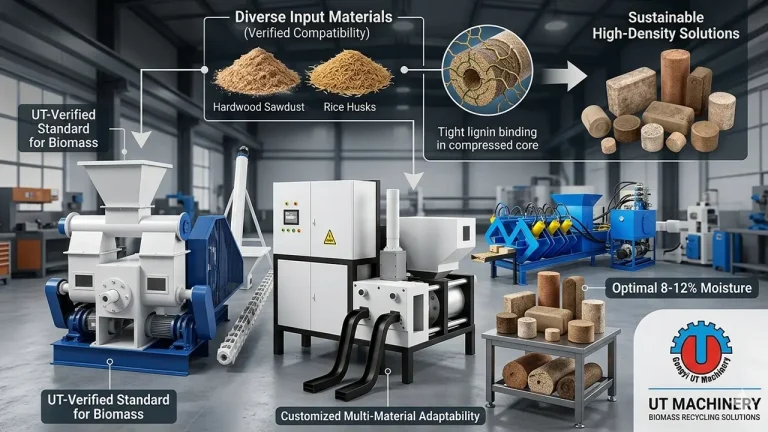
- Moisture Content: Wet biomass or oily metal chips react entirely differently under sudden impact compared to a slow, controlled hydraulic squeeze.
- Target Density: High-end metallurgical recycling requires heavy, solid pucks to reduce burn-off loss in furnaces, heavily favoring controlled pressure profiles.
Structural Differences on the Shop Floor
These two distinct compression methods mean your maintenance team will deal with completely different hardware.
- Inside a Hydraulic Press: You’ll find a hydraulic power unit (HPU), oil tanks, proportional valves, heavy-duty cylinders, and a PLC control panel. Your main maintenance focus will be monitoring oil temperatures, preventing seal leaks, and keeping filters clean.
- Inside a Mechanical Stamping Press: You’ll find electric motors, heavy flywheels, clutches, eccentric crankshafts, connecting rods, and high-wear stamping dies. Your maintenance routine shifts toward mechanical lubrication, checking bearing wear, and monitoring gear alignment under heavy shock loads.
Evaluating the Right Briquetting Technology for Your Application
Instead of asking which machine is superior, look closely at your plant’s operational reality:
Choose a Hydraulic Briquette Press if:
- Your raw material streams vary in type, size, or moisture.
- You need to squeeze out and recover cutting fluids/oil from metal scrap.
- Controlling final briquette density and adjusting pressure on the fly is critical.
- You value a quieter working environment and built-in mechanical overload protection.
Choose a Mechanical Stamping Briquette Press if:
- You run a high-volume, dedicated line processing a single, uniform feedstock.
- You have a consistent, automated material feed system in place.
- Maximum throughput and high pieces-per-minute speed are your primary goals.
Ultimately, the right machine is the one that fits your exact feedstock, throughput targets, and downstream processing requirements—not just a generic industry label.
Explore Related Equipment & Guides
- Ready to dive deeper? Check out our [Complete Guide to Briquette Press Machines].
- Compare technical parameters side-by-side in our [Mechanical vs Hydraulic Briquette Press Comparison Guide].
- Looking for specific machinery? Browse our range of [Hydraulic Biomass Briquette Presses], [Metal Briquette Machines], and [Mechanical Stamping Briquette Machines].
FAQ
Can hydraulic briquette presses process biomass materials?
Yes. Hydraulic presses are widely used in biomass processing, especially when working with variable feedstocks, mixed materials, or when specific, adjustable compaction densities are required.
Are mechanical briquette presses only used for biomass?
No. While they are heavily associated with high-output biomass and charcoal lines, mechanical systems can process certain standardized metal or industrial waste streams if the feeding rate is strictly controlled.
Which briquette press produces higher density briquettes?
Density isn’t determined by the drive system alone. It depends heavily on material prep, moisture, particle size, and how long pressure is applied or maintained in the chamber.
What is the core difference between the two systems?
It comes down to energy delivery: hydraulic systems use fluid power to apply controlled, sustained static pressure, while mechanical systems use flywheels and cranks to deliver rapid, repeating impact force.
How should I start my equipment selection?
Start with your material analysis—evaluate your feedstock type, daily volume, moisture levels, and target output—rather than focusing on the machine type first.